
The PRAXIS Framework is INDEPTH Consulting’s proprietary, purpose-built evaluation architecture for gender-transformative, feminist, and rights-based programme evaluation. The name carries deliberate intellectual weight.
In critical theory — rooted in the foundational work of Paulo Freire and subsequently adopted in feminist scholarship — praxis signifies the integration of theory and practice through sustained critical reflection and transformative action. It is the opposite of mechanical technical procedure. It describes a mode of professional engagement in which the evaluator does not merely apply methods to data but continuously reflects on the relationship between analytical choices, power dynamics, and the emancipatory purposes the evaluation is designed to serve.
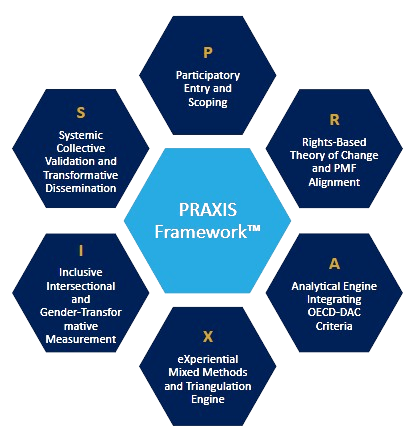
The acronym maps precisely onto the framework’s six-layer architecture:
P — Participatory Entry and Scoping
R — Rights-Based Theory of Change and PMF Alignment
A — Analytical Engine integrating OECD-DAC Criteria
X — eXperiential Mixed Methods and Triangulation Engine
I — Inclusive Intersectional and Gender-Transformative Measurement
S — Systemic Collective Validation and Transformative Dissemination
The acronym is mnemonic and the full form is analytically substantive — each layer corresponds to a discrete phase of evaluation design and execution, and the PRAXIS name makes those correspondences explicit in ways that support both internal team navigation and external stakeholder communication about the evaluation’s architecture.
The PRAXIS Framework is INDEPTH Consulting’s proprietary, purpose-built evaluation architecture for gender-transformative, feminist, and rights-based programme evaluation. The name carries deliberate intellectual weight.
In critical theory — rooted in the foundational work of Paulo Freire and subsequently adopted in feminist scholarship — praxis signifies the integration of theory and practice through sustained critical reflection and transformative action. It is the opposite of mechanical technical procedure. It describes a mode of professional engagement in which the evaluator does not merely apply methods to data but continuously reflects on the relationship between analytical choices, power dynamics, and the emancipatory purposes the evaluation is designed to serve.
The acronym maps precisely onto the framework’s six-layer architecture:
P — Participatory Entry and Scoping
R — Rights-Based Theory of Change and PMF Alignment
A — Analytical Engine integrating OECD-DAC Criteria
X — eXperiential Mixed Methods and Triangulation Engine
I — Inclusive Intersectional and Gender-Transformative Measurement
S — Systemic Collective Validation and Transformative Dissemination
The acronym is mnemonic and the full form is analytically substantive — each layer corresponds to a discrete phase of evaluation design and execution, and the PRAXIS name makes those correspondences explicit in ways that support both internal team navigation and external stakeholder communication about the evaluation’s architecture.
Before any data collection instrument is designed, PRAXIS requires a structured entry and scoping phase with four mandatory outputs. First, a collective feminist positionality statement is produced by all evaluation team members, documenting their social positions, theoretical commitments, and potential biases — making these explicit as analytical inputs rather than invisible distortions.
Before any data collection instrument is designed, PRAXIS requires a structured entry and scoping phase with four mandatory outputs. First, a collective feminist positionality statement is produced by all evaluation team members, documenting their social positions, theoretical commitments, and potential biases — making these explicit as analytical inputs rather than invisible distortions.
The second layer constructs the analytical backbone of the evaluation by mapping the EWG project’s three causal pathways — empowerment and rights assertion, educational attainment, and livelihood enhancement — onto a formal contribution analysis logic framework. Every indicator from the Performance Measurement Framework is matched to its corresponding CEDAW obligation, SDG target, and FIAP action area through a three-way alignment matrix.
The second layer constructs the analytical backbone of the evaluation by mapping the EWG project’s three causal pathways — empowerment and rights assertion, educational attainment, and livelihood enhancement — onto a formal contribution analysis logic framework. Every indicator from the Performance Measurement Framework is matched to its corresponding CEDAW obligation, SDG target, and FIAP action area through a three-way alignment matrix.
The third layer operationalises the five OECD-DAC evaluation criteria through a structured evaluation matrix that maps each criterion to specific evaluation questions, indicators, data sources, and collection methods. Each criterion is assessed through a rights-based analytical lens that is distinctive to the PRAXIS approach:
The third layer operationalises the five OECD-DAC evaluation criteria through a structured evaluation matrix that maps each criterion to specific evaluation questions, indicators, data sources, and collection methods. Each criterion is assessed through a rights-based analytical lens that is distinctive to the PRAXIS approach:
The fourth layer is the methodological core of the framework. PRAXIS employs a sequential explanatory-confirmatory mixed methods design in which qualitative and quantitative strands are not parallel data collection streams but analytically integrated processes. Quantitative instruments generate a landscape of outcome achievement; qualitative instruments are designed specifically to explain the patterns that landscape reveals.
The fourth layer is the methodological core of the framework. PRAXIS employs a sequential explanatory-confirmatory mixed methods design in which qualitative and quantitative strands are not parallel data collection streams but analytically integrated processes. Quantitative instruments generate a landscape of outcome achievement; qualitative instruments are designed specifically to explain the patterns that landscape reveals.
The fifth layer addresses the most intellectually demanding dimension of the evaluation: capturing gender-transformative change, which is non-linear, contested, and poorly served by conventional indicator-based measurement. PRAXIS approaches this through four analytical lenses applied simultaneously across all five country contexts:
The fifth layer addresses the most intellectually demanding dimension of the evaluation: capturing gender-transformative change, which is non-linear, contested, and poorly served by conventional indicator-based measurement. PRAXIS approaches this through four analytical lenses applied simultaneously across all five country contexts: